Market Commentary – Consumer Sentiment Near Historic Lows, Yet Stock Market Setting Multiple Record Highs
By: Eric Sterner, CFA, CAIA, FRM, CIPM
Chief Investment Officer, Apollon Wealth Management and Apollon Financial
It seems a bit ironic that recent consumer sentiment readings are near historic lows, yet the stock market keeps achieving new record highs. In fact, the S&P 500 has set 14 new highs during the past month. We can point to a few factors that may explain this environment including the negativity across social media platforms, the polarizing political landscape, and the ongoing Middle East conflict, but the biggest reason may be the K-shaped economy.
US Consumer
At an aggregate level, the consumer is doing fine, as further evidenced by the recent Retail Sales report, which showed a 0.5% increase in April. While gasoline sales contributed to some of that increase, the report also showed that underlying spending, including at bars and restaurants and online sales continued to rise at a solid pace. Of course, it remains a bifurcated story as the lower end consumer is struggling as the cost of living has increased since the COVID pandemic and inflation is once again on the rise. For the first time in three years, wage growth is failing to keep up with inflation. I expect consumer spending to continue to grow, but at a slower pace, driven by higher earning consumers, who have generated substantial wealth over the past few years from the market and home value appreciation.
Inflation and the Fed
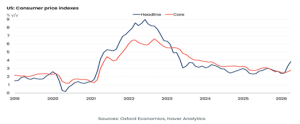
Inflation is once again on the rise, and I expect more increases in the coming months, especially if the conflict in the Middle East continues and traffic through the Strait of Hormuz is not normalized. We saw headline inflation jump to 3.8% in April led by gasoline and jet fuel, which is also increasing airfare costs. If the conflict persists, we will most likely see increases in food prices as higher diesel fuel will push up transportation costs and fertilizer, another export dependent upon the Strait of Hormuz, is also on the rise. The Producer Price Index (PPI) was higher than CPI in April and that may be more important because it has the power to foreshadow what could be coming in consumer prices.
If the US and Iran can agree to a peace deal in the short-term, we could hopefully see a peak on gasoline and oil prices. However, it may take time to see gasoline prices drop down to levels before the war as the fighting has caused oil infrastructure damage across several oil-producing countries in the Middle East.
I think Kevin Warsh will do a great job leading the Fed, but his desire to lower rates may be on hold until these inflationary pressures from the war settle down. If the war does end within a few weeks, I expect the next rate cut to be in December, and I also expect we could see some faster progress in bringing inflation down in the first quarter of 2027. We do have several disinflationary trends in place including shelter costs coming down and tariff pass-through effects winding down. The AI movement will also most likely increase productivity over time, and I expect oil supply to quickly ramp up after the war. The UAE’s exit from OPEC will allow that country to increase production and the sanctions on Russian oil may be lifted longer than the market expects.
Labor Markets
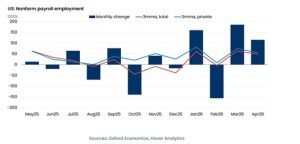
The job market has been healthy for the past several months, but I would not characterize it as strong due to its low hire / low fire nature. However, we may be seeing more strength building from the recent job reports. ADP Private payrolls increased 109K in April, which was double the pace from the prior month and the gains were broad-based. In the JOLTS report, the number of overall hires rose to its highest level since early 2023. Finally, the nonfarm payroll report came in far stronger than expected, as nonfarm payrolls jumped by 115,000 in April, about double the consensus expectation. That followed an even larger 185,000 increase in March and represents the strongest back-to-back gains since the closing months of 2024. It’s too early to call this a trend, but it could be the start of a trend.
1st Quarter Earnings
Of course, it’s very hard to not be bullish after witnessing the best earnings quarter since 2021. As of 5/18/26, the blended year-over-year earnings growth rate was 27.7%. The blended net profit margin for the S&P 500 this past quarter is 14.7%, which is the highest mark since FactSet began tracking this metric in 2009. Bottom-up consensus estimates for the S&P 500 EPS in 2026 and 2027 have each risen by 8% year-to-date. Additionally, S&P 500 companies have reported year-over-year capex growth of 38%.
Summary
I remain bullish, but, as always, we have risks to monitor. In addition to the Middle East conflict, inflation, and the bifurcated consumer story, we need to monitor rising yields. The 10-year treasury eclipsed 4.6% last week, which is a level we have not seen since the 1st quarter of 2025. If deficit and/or inflation concerns keep pushing yields higher, it could certainly slow down this bull market.
Apollon Wealth Management, LLC and Apollon Financial, LLC (“Apollon”) provide advice and make recommendations based on the specific needs and circumstances of each client. For clients with managed accounts, Apollon has discretionary authority over investment decisions. Investing involves risk and clients should carefully consider their own investment objectives and never rely on any single chart, graph, or marketing price to make decisions. The information contained herein is intended for information purposes only, is not a recommendation to buy or sell any security or strategy and should not be considered investment advice. Market performance information and projections have been provided by third-party sources and, although believed to be reliable, have not been independently verified and its accuracy or completeness cannot be guaranteed. Any opinions, projections, forecasts, and forward-looking statements presented herein are valid as on the date of this document and are subject to change. Index returns are gross of fees; investors cannot invest directly in an index. Past performance is no guarantee of future performance. Please contact your financial advisor with questions about your specific needs and circumstances.