Market Commentary – Week 3 of the Iran Conflict
By: Eric Sterner, CFA, CAIA, FRM, CIPM
Chief Investment Officer, Apollon Wealth Management and Apollon Financial
The market and US economy continue to prove its resilience against anything that is thrown against it. Over the past few years, the market and the economy have shown strength during elevated inflation, restrictive interest rates, trade wars concerns, tariff uncertainty, and geopolitical conflicts. While some areas of the market have taken a slight step back due to the Iran conflict, the S&P 500 is only approximately 5% off of its all-time high. I believe the market is still pricing in that this conflict will only last a few more weeks. December Oil Future contracts are trading below $80, which is one piece of evidence to support that statement. Oil is currently in the mid-$90s range.
2026 is a midterm year and affordability will be a main theme, so I believe the White House will be looking for an off-ramp in the short-term as rising gasoline and oil prices will only exaggerate the financial pains of the lower end consumer and the middle class. The Republicans only have a 5-seat majority in the House and the party controlling the White House has lost an average of 21 seats over the past 10 mid-term elections.
Health of the Consumer
At an aggregate level, the consumer is doing fine. However, it remains a bifurcated story with the top 10% of US income earners representing nearly 50% of US consumer spending. The cost of living is approximately 25% higher since 2020 and it clearly is causing more pain for lower income consumers. Rising energy costs will only drive that bifurcation further. The bottom 40% of consumers spend approximately 14% of income on energy, while the top 20% of consumers spend roughly 2% of income on energy.
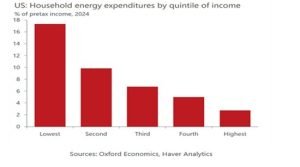
We may see the overall consumer spending data remain healthy as top consumers continue to spend, but the lower and middle classes will struggle even more if energy prices remain elevated for an extended time period. Meanwhile, the labor market remains in a low hire / low fire environment as initial jobless claims remain within their normal range and are not signaling large layoffs.
The Fed and Inflation
As the war continues, we may see some stronger inflation readings in the coming months. Energy and food prices will most likely apply upward pressure on inflation. Diesel fuel is crucial for food prices as it powers farm equipment, and commercial shipping and trucking. Additionally, fertilizer prices are increasing due to the shipping disruptions in the Strait of Hormuz, which are straining farmers during the peak spring season. At the Fed meeting press conference, Jerome Powell signaled that the Fed would still try to look-through a one-time boost to inflation if there were other signs of progress on inflation and inflation expectations remain anchored. There are signs of disinflation in the pipeline, including the fading of the one-time tariff impact on goods prices, and a slowdown in housing inflation, which should put downward pressure on core inflation by the end of this year.
Health of Corporate America
One of the main reasons why the market has remained resilient are the fundamentals. In the 4th Quarter, S&P 500 companies reported 14% in earnings growth, which was the 5th straight quarter of double-digit growth. The blended S&P 500 net profit margin in the 4th quarter was 13.2%, which is the highest level since FactSet began tracking this metric in 2009. Therefore, these large cap companies have a good buffer for the current rising energy costs, and the stock market may be better supported if these metrics remain healthy. There’s more good news on the productivity front as it rose by 2.8% on an annualized basis in Q4, slightly weaker than the 4.7% averaged over the prior two quarters, but this still represents a sizeable gain. I expect productivity will grow more as AI tools and capabilities are more adopted across many sectors.
Tail Risk
Of course, one of the biggest risks in the market is if this Iran conflict lasts months or potentially years. If the White House insists on regime change and/or capturing Iran’s uranium stockpile, it will most likely require “boots on the ground,” which could draw out this conflict much longer. Over the past few days, we witnessed the war enter into a new dangerous phase where attacks are occurring on oil and gas infrastructure. Israel struck at the giant South Pars gas field, and Iran retaliated with an attack on a gas hub in Qatar and fired missiles at a Saudi Arabia oil refinery. Kharg Island has been thrust into the global spotlight because it is regarded as one of Iran’s most sensitive economic targets. The terminal accounts for around 90% of the country’s crude exports and has a loading capacity of roughly 7 million barrels per day. If Kharg Island and/or other oil infrastructure is damaged during this war, it would most likely spike oil prices further and could keep oil prices elevated for an extended time period, even if the war ends in a few weeks.
Tail Risk
The following comments represent my personal views. Apollon’s accounts are managed according to individual objectives and risk and the allocations vary from one client to another.
While a long, drawn-out war is not my base case, investors should prepare for that tail risk. A prolonged war could reignite inflation, dampen consumer spending, weigh on business confidence, and delay a recovery in non-AI investment spending and hiring. We have been tilting our portfolios towards the Quality factor for several months now due to the expected heightened volatility and risks in the markets. Quality factor investing focuses on companies with strong balance sheets and cash flows as well as a strong track record of earnings. According to research from BlackRock, in months when the VIX (volatility index) rose by 20% or more between 1990 and 2019, quality stocks beat the S&P 500 roughly 75% of the time, by an average of about 60 basis points.
As far as sector and asset class views –
- Healthcare – Healthcare has struggled over the past decade and has only outperformed the S&P 500 twice in the last 10 years (2018 and 2022). Both those years were midterm years when volatility has been historically higher. In fact, this sector has outperformed the S&P 500 in 11 of the last 13 midterm election years by an annualized average of 8%, displaying its defensive characteristics. Other tailwinds behind Healthcare include greater clarity on the Trump administration’s healthcare policy, deregulation, lower interest rates, aging demographics across developed economies and AI-led efficiency gains.
- Financials – The Financial sector had a great year in 2025 and was poised for another one coming into 2026. However, the sector got hit by two major headwinds, the White House’s proposal to cap credit card rates and concerns on private credit. I believe the credit card cap rate is just political banter and such a proposal may face challenges in being enacted into law. Credit cards are unsecured lines of credit and banks need to price them accordingly. A cap would hurt banks revenues and profits. Additionally, if a 10% cap was put in place, various studies have estimated 80% of accounts would be closed by banks. At a time when many consumers are struggling to pay bills, such a proposal would cause more harm than good to consumers. Regarding private credit, I believe the concerns are overblown. Roughly 90% of private credit loans are investment grade quality and most corporate balance sheets are healthy. While the media has focused on financial difficulties of a few companies (First Brand and Tricolor), most private credit funds are very diversified with hundreds of loans. There is currently limited evidence of systematic risk among private credit funds, although conditions can change. I believe once those headwinds die down, Financial stocks may rally as M&A activity is likely to pick up in 2026 due to lower interest rates and deregulation. Investors will once again be able to focus on the fundamentals, and Financials are projected to produce the 3rd highest earnings growth of all 11 sectors in the 1st Quarter. The recent proposal by the Federal Reserve to relax capital requirements for banks should also provide some tailwinds for this sector.
- Mid / Small Cap Stocks – Small Cap stocks have several tailwinds behind them including rate cuts, deregulation, and projected earnings growth rates above large caps stocks. Mid / Small caps stocks’ projected earnings growth for 2026 is 24.3%, while large cap stocks are projected to grow 11.4%. Investors may consider focusing on the Quality factor with mid / small cap stocks and focus on profitable companies, such as stocks in the S&P 600. The S&P 600’s valuation is very attractive at approximately 16 right now, which is slightly below its 20-year average of roughly 17. Finally, the OBBA creates tailwinds for small cap stocks as the bill changes the maximum deductible business interest expense from 30% of EBIT to 30% of EBITDA, benefiting firms with high depreciation and debt. Small companies typically have nearly double the depreciation and amortization of large companies, so those smaller companies will benefit more from the bill.
- Information Technology – The AI-driven growth trend continues to be a key theme and this sector has the highest projected earnings’ growth rate in 2026 at 33.5%. Its net profit margin in the 4th quarter was nearly 30%. However, during the first two months of this year, there were strong rotations in the markets and Technology was the 2nd worst performing sector for the first two months of the year. However, since the start of the war, Technology is the 2nd best performing sector, trailing only Energy, as of 3/20/26. Investors typically flock to safety and quality during time of distress and Technology has played that role with its strong balance sheets and earnings.
Apollon Wealth Management, LLC and Apollon Financial, LLC (“Apollon”) provide advice and make recommendations based on the specific needs and circumstances of each client. For clients with managed accounts, Apollon has discretionary authority over investment decisions. Investing involves risk and clients should carefully consider their own investment objectives and never rely on any single chart, graph, or marketing price to make decisions. The information contained herein is intended for information purposes only, is not a recommendation to buy or sell any security or strategy and should not be considered investment advice. Market performance information and projections have been provided by third-party sources and, although believed to be reliable, have not been independently verified and its accuracy or completeness cannot be guaranteed. Any opinions, projections, forecasts, and forward-looking statements presented herein are valid as on the date of this document and are subject to change. Index returns are gross of fees; investors cannot invest directly in an index. Past performance is no guarantee of future performance. Please contact your financial advisor with questions about your specific needs and circumstances.